

1 in 10 Dogs. 1 in 7 Cats. The Silent Heart Disease Crisis Every Pet Parent Should Know About.
Why early heart screening may be one of the most important gifts you can give your pet.
When we think about our pets’ health, vaccinations, nutrition, and regular grooming often come to mind. But one vital organ rarely gets the attention it deserves—the heart.
The truth is startling.
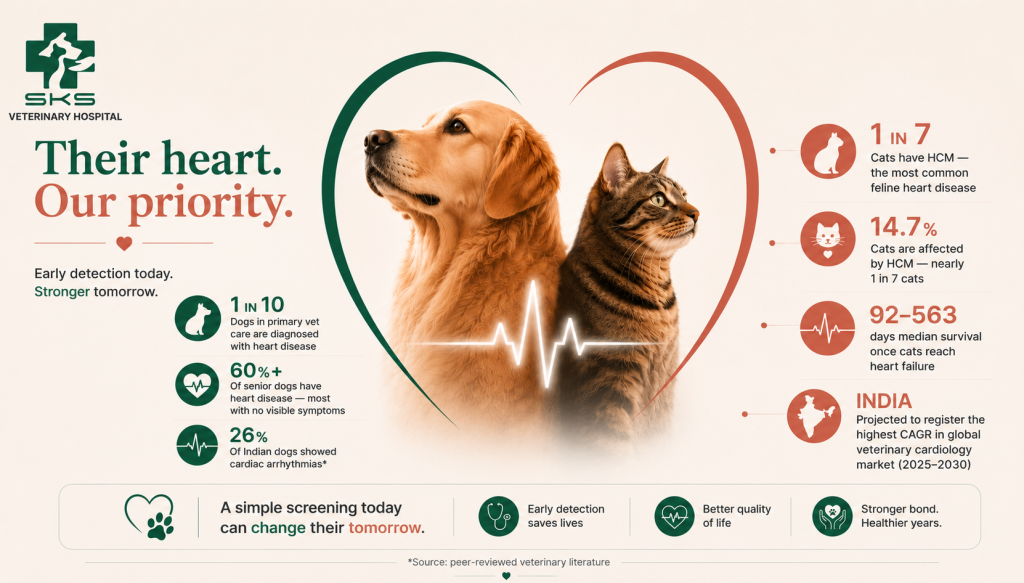
According to recent veterinary research, 1 in 10 dogs visiting primary veterinary practices are diagnosed with heart disease. Even more concerning, over 60% of senior dogs may have underlying cardiac disease, many without showing any obvious symptoms.
For cats, the numbers are equally alarming. Studies estimate that 1 in 7 cats suffer from Hypertrophic Cardiomyopathy (HCM)—the most common heart disease affecting felines.
The biggest challenge?
Most pets don’t tell us anything is wrong.
The Silent Nature of Heart Disease
Unlike injuries or infections, heart disease often develops quietly over months or even years.
A dog may continue wagging its tail and enjoying walks.
A cat may still jump onto the couch and curl up beside you.
Meanwhile, hidden changes inside the heart may already be taking place.
Veterinary cardiologists refer to this as the subclinical stage—a period where the disease exists but outward symptoms are absent.
For many pets, the first noticeable sign can unfortunately be a serious emergency.
This is why preventive heart screening is becoming an increasingly important part of modern veterinary medicine.
What the Research Tells Us
Dogs: More Common Than Most People Think
Recent global veterinary studies indicate that:
-
1 in 10 dogs seen in primary veterinary care are diagnosed with heart disease.
-
More than 60% of senior dogs may have underlying cardiac conditions.
-
Dilated Cardiomyopathy (DCM) is one of the most common serious heart diseases affecting dogs.
DCM causes the heart muscle to gradually weaken, reducing its ability to pump blood effectively. One of the most dangerous aspects of DCM is that it often progresses silently before symptoms become obvious.
According to the Merck Veterinary Manual, many dogs remain in this hidden stage for months or even years.
Large Breed Dogs Face Higher Risk
Certain breeds carry a significantly greater genetic predisposition for heart disease.
These include:
-
Labrador Retriever
-
Golden Retriever
-
German Shepherd
-
Dobermann
-
Boxer
-
Great Dane
-
Saint Bernard
-
Newfoundland
-
Irish Wolfhound
-
Mastiff
If your dog belongs to one of these breeds, routine heart evaluation becomes even more important after five years of age.
Early Detection Changes Everything
One of the most remarkable findings in veterinary cardiology comes from recent survival studies on Mitral Valve Disease.
Researchers found that:
-
Dogs diagnosed during the early, asymptomatic stage had a median survival time of more than 800 days.
-
Dogs diagnosed after the disease had progressed to an advanced stage survived an average of only 184 days.
The difference wasn’t a miracle treatment.
It was simply finding the disease earlier.
Cats: Masters at Hiding Heart Disease
Cats are exceptionally good at concealing illness.
Hypertrophic Cardiomyopathy (HCM), the most common feline heart disease, affects an estimated 14.7% of cats—nearly 1 in 7.
Many affected cats show absolutely no clinical signs until the disease has advanced considerably.
Some may first present with:
-
Difficulty breathing
-
Sudden weakness
-
Collapse
-
Hind limb paralysis caused by blood clots
-
Congestive heart failure
Veterinary studies suggest that many cats can live for years with undiagnosed HCM.
The only reliable way to identify the condition early is through cardiac screening, particularly echocardiography.
Is Your Cat at Higher Risk?
Although any cat can develop HCM, some breeds are genetically predisposed.
These include:
-
Maine Coon
-
Ragdoll
-
Persian
-
British Shorthair
-
Bengal
-
Sphynx
Even mixed-breed cats, however, can develop the condition, making routine evaluation important for all senior cats.
What About India?
Recent Indian veterinary research paints a similar picture.
A 2024 study published in the Indian Veterinary Journal found that:
-
26.21% of dogs evaluated for generalized disease histories showed cardiac arrhythmias.
-
Labradors had the highest breed-specific occurrence at 29.82%.
-
Dogs above six years of age accounted for nearly 60% of all arrhythmia cases.
Another Indian study found that more than half of dogs presenting with cardiac symptoms were confirmed to have heart disease after ECG, X-ray, and echocardiographic evaluation.
These findings reinforce what veterinary cardiologists around the world already know:
Heart disease is not rare. It is simply underdiagnosed.
Signs Every Pet Parent Should Watch For
Although many pets remain symptom-free initially, consult your veterinarian if you notice:
-
Tiring easily
-
Excessive panting
-
Persistent coughing
-
Rapid or difficult breathing
-
Reduced activity levels
-
Weakness or collapse
-
Fainting episodes
-
Loss of appetite
-
Restlessness while sleeping
Remember, the absence of symptoms does not necessarily mean the absence of disease.
How Can Heart Disease Be Detected?
Modern veterinary cardiology offers several advanced diagnostic tools:
Cardiac Consultation
A specialist examination and detailed medical history.
ECG (Electrocardiogram)
Detects abnormal heart rhythms.
Echocardiography (2D Echo)
Provides real-time ultrasound imaging of the heart.
Blood Pressure Monitoring
Helps identify hypertension-related cardiac complications.
Thoracic X-Ray
Assesses heart size and lung involvement.
Together, these tests allow veterinarians to identify many cardiac conditions long before they become critical.
Prevention Is Better Than Emergency Treatment
Many heart diseases cannot always be prevented.
But they can often be managed successfully if discovered early.
Timely diagnosis allows:
-
Better quality of life
-
Longer survival
-
Earlier medical intervention
-
Reduced risk of emergency heart failure
-
More years of companionship
For many families, a routine heart screening becomes one of the most valuable health checks their pet will ever receive.
SKS Heart Pawject
At SKS Veterinary Hospital, we believe that awareness is the first step toward prevention.
SKS Heart Pawject was created to encourage pet parents to think about heart health before symptoms appear.
Because the heart that unconditionally loves you deserves looking after too.
Currently happening in Vizag, know more here.
Key Takeaways
 1 in 10 dogs seen in veterinary practice have heart disease.
More than 60% of senior dogs may be affected.
1 in 7 cats may have Hypertrophic Cardiomyopathy.
Over one-quarter of Indian dogs studied showed cardiac arrhythmias.
Many pets show no visible symptoms until the disease is advanced.
Early screening through ECG and echocardiography can dramatically improve outcomes.
Statistics referenced in this article are derived from peer-reviewed veterinary literature, including Grand View Research, Merck Veterinary Manual, DVM360, Cornell Feline Health Center, the Royal Veterinary College CatScan Study, the Indian Veterinary Journal (ICAR), and other published veterinary cardiology research.